

What is Tantra?
An honest guide
A women-centred guide to what Tantra actually is — its history, the truth about sex and Tantra, and
how therapeutic Tantric bodywork works in Sukh Tantra Newcastle.
Understanding Tantra
An honest introduction, for the women who want to know more
Most people have heard the word Tantra. Very few have been told what it actually means.
If you've arrived here, it's probably because something in you is curious — not about a technique or a trend, but about a different way of being with your own body, breath and attention. That curiosity is a great starting point.
What Tantra actually is
Tantra is one of the world's great body-affirming traditions. It emerged in India more than 1,500 years ago, and where many spiritual paths asked people to rise above the body, Tantra took a bolder position: the body is not an obstacle to awareness, but a doorway into it.
The word itself comes from the Sanskrit root tan — to extend, to weave. And that's the spirit of the whole tradition. Tantra doesn't ask you to divide yourself into acceptable and unacceptable parts. It asks what becomes possible when body, breath, emotion, energy and awareness are allowed to belong to the same whole.
For a woman who has spent years living slightly above her own body — functioning, caring, achieving, accommodating — that idea can feel less like a philosophy and more like a homecoming.
Tantra origins, briefly
Tantra is not one religion or one school. It's a vast family of traditions that grew across India from around the sixth century CE and later travelled through Nepal, Tibet and much of Asia, taking form within Hinduism, Buddhism and beyond. Different lineages had their own deities, rituals and philosophies. What united them was a single conviction: that ordinary human experience — sensation, breath, desire, the body itself — could be transformed into a genuine path.
One text captures it beautifully. The Vijñāna Bhairava Tantra offers 112 short meditations, many beginning not with withdrawal from the world but with the breath, a sound, a moment of pleasure, the space between two thoughts. The invitation to be fully present in your own body isn't a modern wellness idea. It's one of the oldest and most carefully considered practices we have.
What about Shiva and Shakti symbolism?
Scriptures say that Lord Shiva gave Yoga, from which Tantra path was developed later. Lord Shiva is God- Paramatman or Spirit. The manifestation or creation created by God is Shakti- the Goddess, Mother Nature, Prakriti.
Some Tantra paths use these names to symbolise sexuality and that is far from the scriptural truth and, wrong. Pages can be written about such wrong notions, but here it’s important to understand this true meaning of Shiva and Shakti.
How classical Tantra was practised
Classical Tantra was far richer and more disciplined than its modern reputation suggests, and the methods varied between Hindu and Buddhist lineages. Practice might include mantra — sacred sound used to concentrate awareness; meditation and visualisation; breath and subtle-body work with prāṇa, the vital energy behind our modern ideas of chakras and kundalini; yantras and mandalas, sacred geometric forms entered into rather than simply looked at; mudras, symbolic gestures of the hands or whole body; and elaborate ritual. Much of it was passed from teacher to student through initiation — Tantra was never just a set of techniques, but something embedded in lineage, relationship and responsibility.
Is Tantra about sex?
It's the question almost everyone arrives with, so let me answer it directly. No — Tantra is not synonymous with sex. The great majority of classical practice was mantra, meditation, ritual and breathwork, with no sexual element at all.
Some historical lineages did include what may be perceived today as sexual rites, but within their setting these were never about better sex — they were demanding rituals aimed at dissolving deeply conditioned divisions between sacred and profane, pure and impure. Much of the modern confusion is a colonial inheritance: Modern observers fixed on Tantra's most transgressive edges, and by the twentieth century its modern image had narrowed almost entirely to pleasure. That modern strand — Neo-Tantra — placed sexuality much closer to the centre.
5 Koshas: A map of the whole person
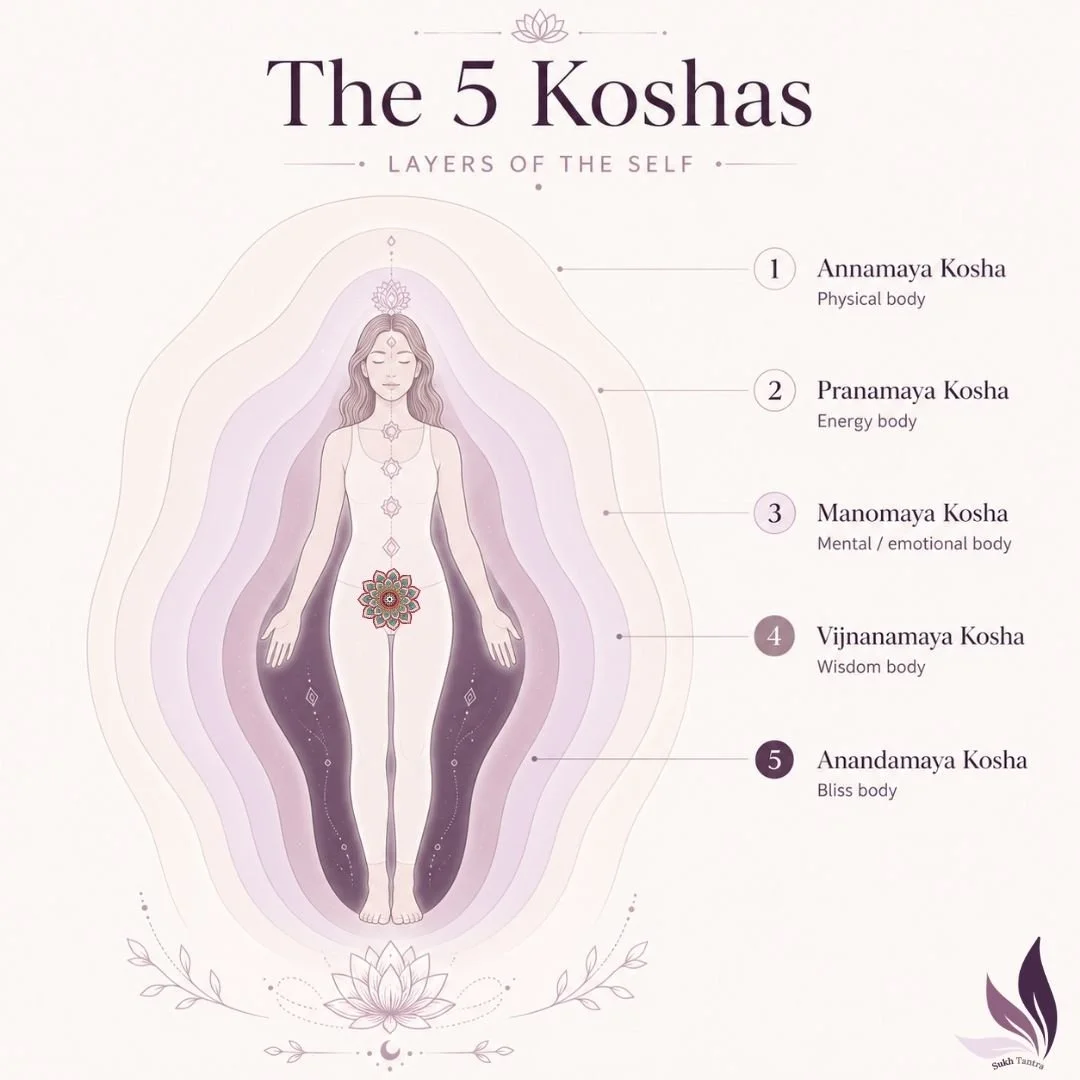
The koshas come from the Taittirīya Upanishad and the wider Yogic tradition, and offer one of its most useful ideas: that a human being is far more than a physical body. They aren't Tantric in origin, but they map beautifully onto what Tantra seeks — to weave the body, its energies and its awareness back into one whole, rather than treating them as separate.
Kosha means a sheath or layer, and the model describes five of them, interwoven — Annamaya, the physical body; Prāṇamaya, the energy and breath body; Manomaya, the mental and emotional body; Vijñānamaya, the wisdom body that can witness an experience rather than be consumed by it; and Ānandamaya, the subtle body of deep contentment and wholeness.
These aren't literal anatomical structures — they're a way of recognising that a person experiences herself all at once: physically, energetically, emotionally, intuitively, and through a deeper felt sense of simply being.
At Sukh Tantra, they express one simple principle:
You are more than a body - You are a whole person having an experience.
Why women explore Tantra
Women come to Tantra for reasons as varied as their lives. Some have lost touch with what they feel or need after years of caring for everyone else. Some are moving through change — in hormonal seasons, in desire, intimacy, body confidence or identity. Some carry the quiet ache of feeling disconnected from themselves, and some hopw to get past stuck patterns or imprints of difficult experiences. Sexuality is part of the picture for some women and not for others. Every reason that brings you here is completely welcome.
What draws most women here, in the end, is a single unspoken question: what would it feel like to come home to my own body? To be met with attention and ease, with nothing to perform and nothing to prove.
Nothing added. Nothing expected. Simply more of you becoming available to you.
What Tantra work really offers
Tantra is often sold as a doorway to extraordinary experiences. Its quieter invitation is the more meaningful one — and the more honest.
Tantric bodywork gives you a structured, unhurried space to notice your breath, your sensations, your boundaries, and what it feels like simply to receive. It can makew you aware of where you soften and where you protect yourself, what feels good and what doesn't. Not a performance to chase or a reaction to produce — but a way of becoming present — enough to hear yourself.
So there's no getting it right’pressures. You might feel relaxation, emotion, insight, stillness, or something totally different. The aim is never to manufacture a particular response.
It's goal is to create the conditions in which you can meet yourself — honestly, and without hurry.
To breathe without immediately changing what you feel
To notice a sensation without rushing toward it or away
To set down what you've carried so long it started to feel like you
To let go of something you didn't realise you were holding.
To recognise a boundary before it has to become a wall
To meet yourself again — not as you should be, but as you are.
To remember that your body, emotions, energy and inner knowing all belong to the same person
Tantra doesn't ask you to fix yourself or become anyone different.
It invites you to feel yourself fully — and to stop leaving parts of yourself behind.
Your questions, answered
-
No. Most classical Tantra was mantra, meditation, ritual and breathwork. Sexual ritual existed within some specialised lineages, but was never the whole of it.
-
Classical Tantra refers to the initiatory Hindu and Buddhist traditions that developed in India from the middle of the first millennium CE. Neo-Tantra refers to modern, largely Western interpretations that focus more on embodiment, pleasure, intimacy and sexuality.
-
No. You need no spiritual background, no body confidence and no previous experience.
-
If you're unsure, begin with a discreet discovery call — the simplest way to ask your questions and work out together which service best matches what you're looking for.
-
Because your inner life is your own. Discretion here is respect for your private world — the same care you'd expect from anyone you trust with something personal. Tantra still gets misread-as sexual, somewhat mysterious- and you shouldn't have to explain your choices to anyone. What you explore, and the fact that you chose to, stays with you.
-
That's honest, and more common than you'd think. Nervousness is welcome here; it doesn't have to go away before you begin.
Think of Tantra as bodywork with more attention paid to breath, presence and how you're feeling. Every step is explained before it begins, nothing intimate is ever assumed, and you set the pace throughout. Many women find that what felt daunting as a word feels quite natural as an experience.
If it helps, a discovery call is a low-pressure way to ask anything before you decide.
-
Not a single, separate one. It's a broad family of texts, philosophies and practices that developed within several Indian traditions — particularly Hinduism and Buddhism. Modern therapeutic Tantra draws on them without functioning as religious instruction.
-
Not identically. It's classical Tantra principles woven with modern somatic practices influenced by Tantra's attention to breath, embodiment, energy and awareness. A credible practitioner will always be transparent about that distinction.
-
No. Tantric bodywork is not medical care, psychotherapy or a substitute for it.
Some Tantra practices and bodywork help nervous system regulation and may therefore help to get relief from some effects of trauma but are not replacement for medical care where necessary.