

What is Tantra?
An honest guide to its origins, philosophy, modern meaning and work involved
For those curious about knowing more theory
Tantra is Integration, not rejection
Tantra is one of the most misunderstood words in modern wellbeing. Ask ten people and you'll hear meditation, spirituality, sex or Tantric massage. Historically, none of these on its own is accurate.
Tantra is one of the world's great body-affirming traditions, coming from a large and diverse family of traditions; each developed its own philosophy, deities, rituals and methods. It emerged in India more than 1,500 years ago, and where many spiritual paths asked people to rise above the body, Tantra took a bolder position: the body is not an obstacle to awareness and transformation, but a doorway into it.²
The word Tantra comes from the Sanskrit root tan — to weave, to connect. Tantra also means Technique. And that's the spirit of the whole tradition. Tantra doesn't ask you to divide yourself into acceptable and unacceptable parts. It’s a technique to weave together all parts of your existence- body, breath, emotion, energy and awareness- and to experience what becomes possible when they are allowed to belong to the same whole.
Tantra origins, briefly
Tantra is not one religion or one school. It's a vast family of traditions that grew across India from around the sixth century CE and later travelled through Nepal, Tibet and much of Asia, taking form within Hinduism, Buddhism and beyond. Different lineages had their own deities, rituals and philosophies. What united them was a single conviction: that willingness to work with ordinary human experience — the body, sensation, breath, attention and the desire itself — could be transformed into a genuine path combining with mantra, meditation and ritual.
One text captures it beautifully. The Vijñāna Bhairava Tantra offers 112 short meditations, many beginning not with withdrawal from the world but with the breath, a sound, a moment of pleasure, the space between two thoughts. The invitation to be fully present in your own body isn't a modern wellness idea. It's one of the oldest and most carefully considered practices we have.
How classical Tantra was practised
Classical Tantra was far richer and more disciplined than its modern reputation suggests, and the methods varied between Hindu and Buddhist lineages. Practice might include mantra — sacred sound used to concentrate awareness; meditation and visualisation; breath and subtle-body work with prāṇa, the vital energy behind our modern ideas of chakras and kundalini; yantras and mandalas, sacred geometric forms entered into rather than simply looked at; mudras, symbolic gestures of the hands or whole body; and elaborate ritual. Much of it was passed from teacher to student through initiation — Tantra was never just a set of techniques, but something embedded in lineage, relationship and responsibility.
5 Koshas: A map of the whole person
Tantric and yogic traditions describe several elements of the subtle body:
Prāṇa, or vital life energy
Nāḍīs, or channels
Chakras, or centres
Kundalini, a transformative power awakened through practice
Atma or the subtle ody or Soul
These are traditional maps of inner experience, not anatomical structures discovered by modern medicine. There was also never one chakra system shared by every tradition. What these maps show is that many traditions saw human experience as more than the physical body alone.
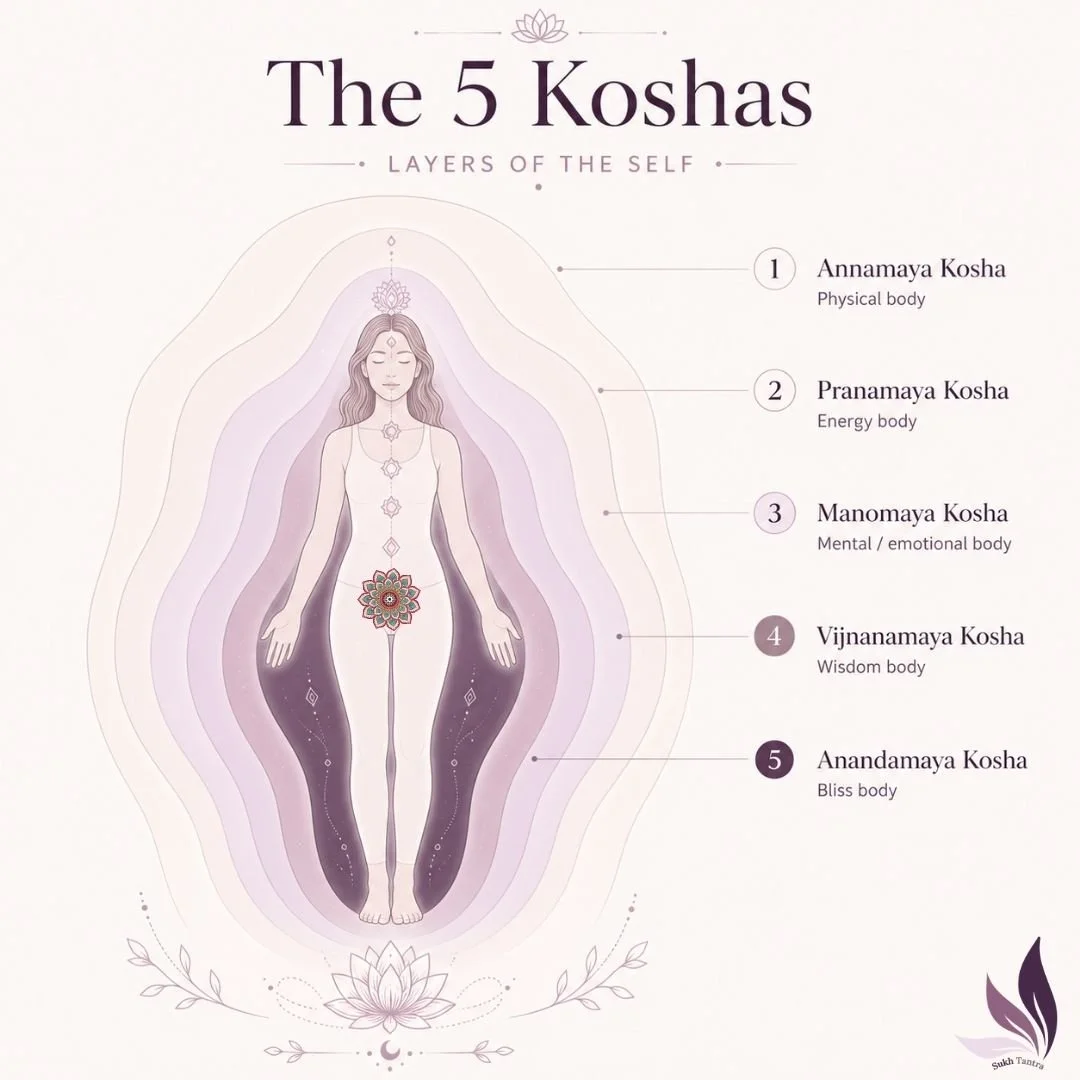
The koshas come from the Taittirīya Upanishad and the wider Yogic tradition, and offer one of its most useful ideas: that a human being is far more than a physical body. They aren't Tantric in origin, but they map beautifully onto what Tantra seeks — to weave the body, its energies and its awareness back into one whole, rather than treating them as separate.
Kosha means a sheath or layer, and the model describes five of them, interwoven — Annamaya, the physical body; Prāṇamaya, the energy and breath body; Manomaya, the mental and emotional body; Vijñānamaya, the wisdom body that can witness an experience rather than be consumed by it; and Ānandamaya, the subtle body of deep contentment and wholeness.
These aren't literal anatomical structures — they're a way of recognising that a person experiences herself all at once: physically, energetically, emotionally, intuitively, and through a deeper felt sense of simply being.
At Sukh Tantra, they express one simple principle:
You are more than a body - You are a whole person having an experience.
What "Energy" means in Tantra
Traditional systems speak of Shakti, Prāṇa and Kundalini within precise philosophical frameworks. Modern practitioners often use "energy" more loosely, to describe aliveness, warmth, arousal, emotional intensity or a shift in attention.
The two meanings aren't identical. At Sukh Tantra, energetic language is offered as a useful framework for experience.
Einstein has scientifically proved E= mc², means all matter is energy and vice a versa. However, modern anatomy or medicine has not accepted this view yet though they use various forms of energy like radiation routinely.
What about Shiva and Shakti symbolism?
Scriptures say that Lord Shiva gave Yoga, from which Tantra path was developed later. Lord Shiva is referred to as God- Paramatman or Spirit. The manifestation or creation created by God is Shakti- the Goddess, Mother Nature, Prakriti, divine creative power itself.⁴
Some Tantra paths use these names to symbolise sexuality and that is far from the scriptural truth and, wrong. Pages can be written about such wrong notions, but here it’s important to understand this true meaning of Shiva and Shakti.
Shiva and Shakti are rich philosophical and theological ideas, not ancient labels for male and female sexuality.
Is Tantra Spiritual?
Historically, yes. Tantra developed within religious traditions concerned with consciousness, liberation, deity and the nature of reality.¹
Exploring Tantra-inspired practice today asks none of that of you. You don't need to believe in a deity, take chakras literally, describe sensation as mystical energy or consider yourself spiritual.
Traditional Tantra offers the philosophy. Modern practice can draw on it without requiring the belief.
Is Tantra about sex?
It's the question almost everyone arrives with, so let me answer it directly. No — Tantra is not synonymous with sex. The great majority of classical practice was mantra, meditation, ritual and breathwork, with no sexual element at all.
Mistaking Tantra for sex is like mistaking yoga for gymnastics.
Some historical lineages did include what may be perceived today as sexual rites, but within their setting these were never about better sex — they were demanding rituals aimed at dissolving deeply conditioned divisions between sacred and profane, pure and impure. There are some ancient carvings on temple walls which are sexual in nature. Perhaps in those days they saw sex energy as the potent energy capable of pro-creation, than to its limited view of orgasm or gratification.
Much of the modern confusion is a colonial inheritance: Modern observers fixed on Tantra's most transgressive edges, and by the twentieth century its modern image had narrowed almost entirely to pleasure. That modern strand — Neo-Tantra — placed sexuality much closer to the centre and that’s their choice.
Neo-Tantra has also absorbed some ideas that aren't classically Tantric. These include Taoist energy practices, Western psychotherapy, Reichian body theory, modern sexology and contemporary somatic work.⁵ Many modern books blend these sources without saying so. A breathing technique may be Taoist. Muscular "armouring" comes from twentieth-century psychotherapy.
None of that makes a practice incorrect or less valuable. It simply means being honest about where it comes from.
Is Tantra about sacred sexuality?
I find "sacred sexuality" an odd pairing. Some use that term, and that’s theirs to use.
As I understand the older Tantra teachings, sexual energy was seen as the energy of creation, available for every species- human, animals, even plants- for the continuation of life. Used for that purpose, and held within love, it was regarded as a genuine expression of that creative aspect of life energy. Pursued for lust alone, it drifts from what it was meant for. To me, this is where sexual energy has been misread, in mainly modern schools of Tantra.
What is Therapeutic Tantra?
Therapeutic Tantra is not simply another way of saying non-sexual or non-erotic. It goes much deeper than that.
The word “therapeutic” describes the intention behind the bodywork — to support relaxation, body awareness, reconnection and a greater sense of wellbeing, and sometimes to help tap into your body’s innate potential for healing and restoration.
Tantric bodywork works with more than the physical body alone. Through conscious therapeutic touch, breath, energy, movement and present-moment awareness, it invites you to slow down and notice what is happening within you — not only in your body, but in the way you experience sensation, emotion and connection with yourself. Research into mindfulness and interoception — our ability to sense and become aware of what is happening within the body — supports the idea that present-moment attention can deepen body awareness.⁶ ⁷
For many women, life can gradually create patterns of holding, disconnecting, overthinking or simply getting on with things. We may become accustomed to tension without realising we are carrying it, or lose touch with parts of ourselves that once felt alive, expressive or deeply connected.
This can feel particularly familiar for women moving through perimenopause and menopause. Many women who come here describe it in words such as: “It feels like my mind and body are in different worlds — my mind wants peace, but my body does not cooperate.” Massage and body-based interventions have also been studied in menopausal and postmenopausal women, with research suggesting potential benefits across aspects of physical and psychological wellbeing.⁸
Therapeutic Tantra creates a space where some of those patterns can begin to soften — where the body and mind have an opportunity to come back into greater alignment.
Rather than trying to force an outcome, the work encourages presence — allowing the body to be experienced with curiosity rather than judgement or expectation. Research into body awareness and interoceptive approaches suggests that becoming more aware of internal bodily sensations can itself be a meaningful part of reconnecting with the body.⁶ ⁷
Within Tantra, this experience is also understood through the language of energy — noticing where you feel open or contracted, alive or disconnected, flowing or held. As awareness deepens and energy begins to move more freely, there can be opportunities for release, insight, reconnection, realignment and healing to emerge in ways that are unique to each woman.
Sometimes the shift is subtle: feeling calmer, more grounded or more at home in your body. At other times, the experience may open a doorway into deeper self-awareness, greater sensitivity, emotional release, renewed vitality, or a different relationship with pleasure and intimacy — with yourself and with the world around you.
This is the therapeutic potential of Tantra — not a promise to “cure” or “fix” as Tantra believes nothing is broken, but an invitation to create the conditions in which your own body, awareness and inner intelligence may reveal new possibilities.
Every woman’s experience is different, and individual results naturally vary.
“Therapeutic” does not mean that Tantra is a substitute for medical, psychological, physiotherapy or other healthcare treatment.
How bodywork became Tantra?
Tantra Bodywork is a different way of experiencing Your Body and Yourself.
Tantra, as I practise and understand it at Sukh Tantra, is fundamentally about bringing awareness back into the body.
The body, breath and lived experience can become places of awareness, not obstacles to it- is one of the themes evolved in Tantra over time.
Most of us spend an enormous amount of our lives in thought — planning, analysing, anticipating, remembering, evaluating and trying to get somewhere. Sexuality can become surprisingly similar. There can be an expectation to respond in a particular way, please somebody else or prove that everything is working as it should.
Tantric practice offers another possibility.
Through breath, conscious awareness, unhurried touch, stillness and attention to sensation, the emphasis moves away from what should happen next and towards what you are actually experiencing now.
Warmth. Tingling. Softness. Pressure. Resistance. Pleasure. Vulnerability. A deeper breath. A feeling of expansion. Perhaps very little at first.
There is no correct response.
The intention is not to manufacture an experience. It is to become sufficiently present to notice the experience your body is already having.
Research into several practices used within contemporary embodied Tantra — particularly mindful attention, body awareness and slow breathing — does support their capacity to influence how people notice bodily sensations and how the nervous system regulates itself.
What encient wisdom knew, modern evidence is starting to discover⁹.
What Tantra Is Not
It is not the Kama Sutra. The Kama Sutra belongs to a separate tradition concerned with kāma: pleasure, relationships and social life.
It is not sexual technique. Sexual practice was one element within some traditions. (see Energy section below)
It is not a erotic massage. Some bodywork is a contemporary practice influenced by Neo-Tantric ideas.
It is not "man and woman." Shiva and Shakti mean far more than that.
It is not interchangeable with Neo-Tantra. The two overlap, but they are different traditions.
Your questions, answered
-
No. Most classical Tantra was mantra, meditation, ritual and breathwork. Sexual ritual existed within some specialised lineages, but was never the whole of it.
-
Classical Tantra refers to the initiatory Hindu and Buddhist traditions that developed in India from the middle of the first millennium CE. Neo-Tantra refers to modern, largely Western interpretations that focus more on embodiment, pleasure, intimacy and sexuality.
-
No. You need no spiritual background, no body confidence and no previous experience.
-
Not a single, separate one. It's a broad family of texts, philosophies and practices that developed within several Indian traditions — particularly Hinduism and Buddhism. Modern therapeutic Tantra draws on them without functioning as religious instruction.
-
Not identically. It's classical Tantra principles woven with modern somatic practices influenced by Tantra's attention to breath, embodiment, energy and awareness. A credible practitioner will always be transparent about that distinction.
Curious where this could lead?
References
References
R.K. Payne & G.A. Hayes (eds), The Oxford Handbook of Tantric Studies, Oxford University Press; G. Samuel, The Origins of Yoga and Tantra, Cambridge University Press, 2008.
Payne & Hayes (eds), The Oxford Handbook of Tantric Studies, Oxford University Press.
Payne & Hayes (eds), The Oxford Handbook of Tantric Studies; D.G. White, Kiss of the Yoginī: "Tantric Sex" in Its South Asian Contexts, University of Chicago Press, 2003.
Payne & Hayes (eds), The Oxford Handbook of Tantric Studies, Oxford University Press.
Payne & Hayes (eds), The Oxford Handbook of Tantric Studies; H.B. Urban, Tantra: Sex, Secrecy, Politics, and Power in the Study of Religion, University of California Press, 2003.
Molteni, L., Gosling, C. J., Fagan, H. A., et al. (2024). Effects of mindfulness-based interventions on symptoms and interoception in trauma-related disorders and exposure to traumatic events: Systematic review and meta-analysis. Psychiatry Research, 336, 115897. https://doi.org/10.1016/j.psychres.2024.115897
Heim, N., Bobou, M., Tanzer, M., Jenkinson, P. M., Steinert, C., & Fotopoulou, A. (2023). Psychological interventions for interoception in mental health disorders: A systematic review of randomized-controlled trials. Psychiatry and Clinical Neurosciences, 77(10), 530–540. https://doi.org/10.1111/pcn.13576
Lu, X., Xu, X., Shi, X., et al. (2026). Can massage ameliorate menopausal and postmenopausal symptoms in women? A systematic review and meta-analysis. Complementary Therapies in Medicine, 98, 103370. https://doi.org/10.1016/j.ctim.2026.103370
¹ WHO (2006), Defining sexual health · ² Burleson, Trevathan & Todd (2007), Archives of Sexual Behavior · ³ Davison et al. (2009), Journal of Sexual Medicine · ⁴ Lastella et al. (2019), Frontiers in Public Health; (2025), Sleep Health · ⁵ Liu et al. (2016), Journal of Health and Social Behavior · ⁶ The Menopause Society, Sexual health and menopause FAQs · ⁷ Byers (2005), Journal of Sex Research · ⁸ Friedman & Martin (2011), The Longevity Project · ⁹ Basson (2000), Journal of Sex & Marital Therapy