


❋
5 ways Tantra may benefit Women
Feeling safe, calm, present and at home in your body again.
This is one of the more detailed pages on the site, because the questions women bring to Tantra deserve thoughtful, honest answers. Take your time with it.
So much of what we carry is rarely visible from the outside.
We learn to hide our emotions so well that sometimes even we stop listening to them.
We know exactly how to love, nurture and care for others, yet asking for the same for ourselves can feel almost uncomfortable — even guilty.
We get used to putting our own needs last, until one day we realise we have been giving from an empty cup.
Tantra creates space to turn inward again — to feel what has been pushed aside, receive without guilt, and reconnect with yourself beneath all the giving.
An honest take, for the women who want to know more
If you've arrived here, it's probably after a lot of reflection, something within you trying to express or urging to listen. Or because something in you is curious. It isn't about a technique or a trend, but about a different way of being with your own body, breath and attention. That curiosity is also a great starting point.
Understanding Tantra is one thing. Feeling what it means in your own body is something quite different.
Tantra holds - Your body is not a problem to fix or solve. But it is somewhere you can stay, learn and thrive. For a woman who has spent years living slightly above her own body — functioning, caring, achieving, accommodating — that idea can feel less like a philosophy and more like a homecoming.
Coming to Tantra? Every reason is welcome

Women come to Tantra for reasons as varied as their lives. Some have lost touch with what they feel or need. Some are going through change — hormonal seasons, desire, intimacy, body confidence or identity. Some are trying to understand body’s language of symptoms. Some hope to move past stuck patterns or the imprint of difficult experiences. Sexuality is part of the picture for some women and not for others.
What draws most women here, in the end, is a single unspoken question: what would it feel like to come home to my own body?
You may find this work supportive if you:
Feel disconnected from your body, battle a busy mind, or live mostly in your head
Have had your boundaries crossed in the past and want to rebuild a sense of choice, ownership and trust in your own body. Some refer as- “remove his energy that feels stuck within” or “ take my power back”.
Tense, brace or hold your breath when touched, without always knowing why
Feel intimacy has become a chore or a performance, or has simply gone quiet
Are moving through change, such as menopause, life after childbirth, the end of a relationship, or starting a new chapter. Many women in perimenopause who come here describe it in words such as: “It feels like my mind and body are in different worlds — my mind wants peace, but my body does not cooperate.”
Give endlessly to others and rarely allow yourself to receive
Find it hard to relax, even when you finally have the chance
Are simply curious about Tantra or,
Feel keen and excited about knowing yourself more deeply
You don't need a problem to explore this work.
Nothing to prepare. Nothing expected.
Simply more of you, available to you.
What Women tell me afterwards matters most
After years of this work, one thing has become clear to me: Women seek safety and connection before anything else. What they want is simple: for their body to feel like their own again, and for their boundaries to be respected while that happens.
What they tell me most isn't about Tantra. It's about what changed in them.
During the session, many notice the moment their breath drops lower. A long sigh that finally lets go of something. Places that have felt numb or guarded begin to warm. Sensation returns. Some cry without quite knowing why, and find it's a release rather than a weight.
Afterwards, what they say is what matters the most:
"I feel safe and calm."
"I didn't have to brace."
“I feel more aligned, more balanced.”
"I feel more at home in my skin, again."
Before I go any further
Being a man, I don't know first-hand what it's like to live inside a woman's body, and I won't pretend to understand everything you may have been through.
My understanding comes from years of working with women, listening closely to what they share, studying Tantra and somatic practice, and learning how differently a person's body responds when it's given time, attention and safety.
I bring experience, knowledge and care. But I don't get to tell you what your body should feel.
You remain the authority on that.

At Sukh Tantra,
I keep it simple:
You have a body.
The body produces sensation.
You can learn to notice that sensation more closely.
Your breath can change how you experience it.
Slowing down reveals what rushing often misses.
Emotions can rise and be felt, without needing a reaction.
The ripples settle, and the lake grows clear.
In that stillness, healing can begin.
5 ways Tantra can benefit women:
1. Knowing the layers of you
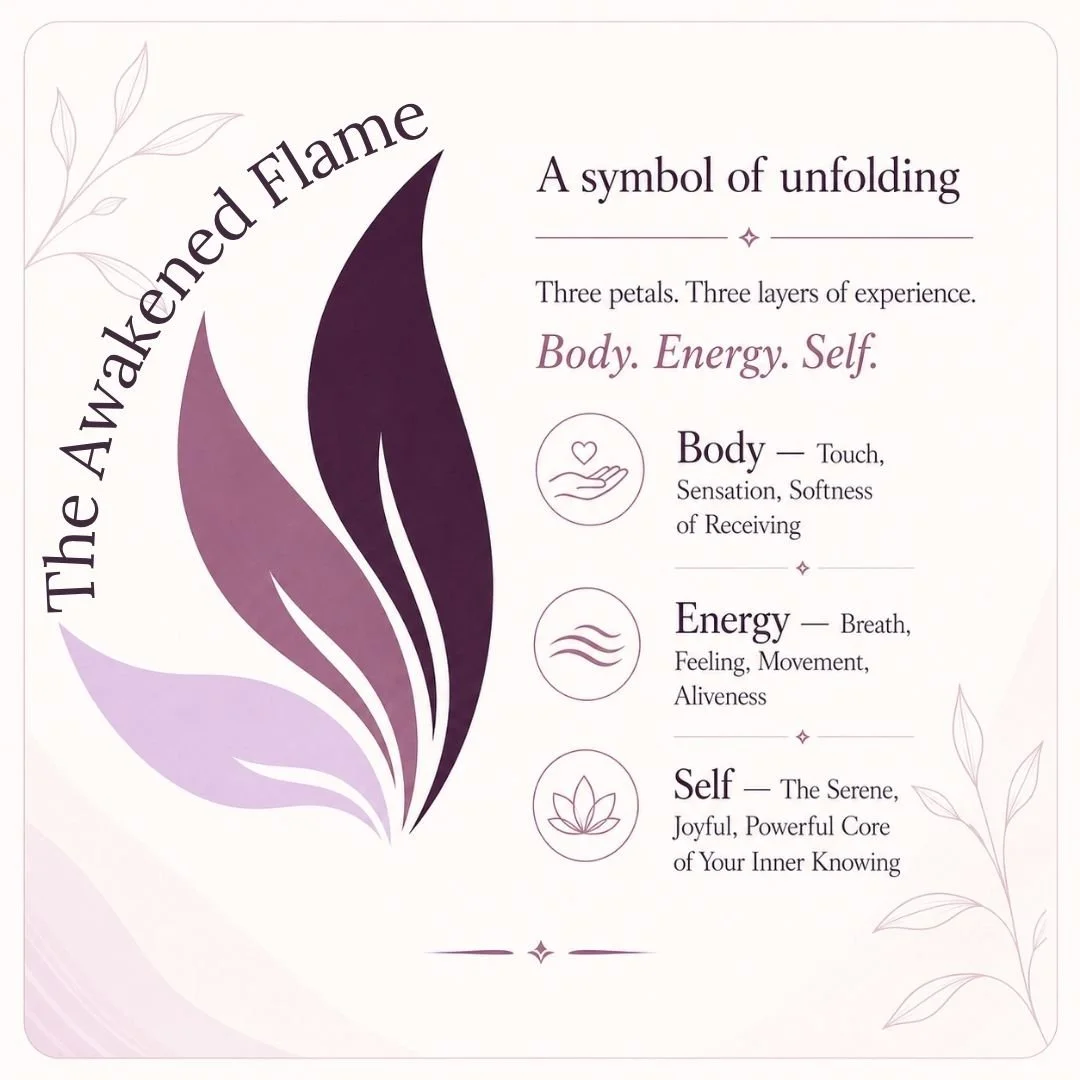
Tantra sees layers that make a ‘whole’ woman: her body, her emotions, energy, and her inner self.
Life can slowly pull these apart. But when they're gently brought back into relationship with one another with Tantra practices, something quiet but profound happens. You soften, you open, you return to yourself.
Our symbol, The Awakened Flame, distils this into three flowing petals: three layers a woman can allow herself to truly feel in this work.
Together they rise into a flame, one that quietly awakens inner peace and strength. One that opens the door towards healing.
This is Tantra's real invitation: not to become someone new, but to remember the flame that already lives within you.

2. How Tantra helps the body feel Safe again
Tantra bodywork aims to create conditions where you can become present, enough to hear yourself.
Your nervous system learns through experience, not through words or reassurance. Being told you're safe isn't the same as feeling it.
That's why you lead every session. Each time you notice what you want, say it, and it's respected, something rebuilds: trust in your own signals, a knowing with certainity.
Tantra sometimes uses words like opening and surrender. I use them carefully. Opening should never mean overriding your body's reluctance, and surrender should never mean handing your authority, or your power, to anyone. The aim isn't to push past resistance, but to listen closely enough to understand it.
My Tantra bodywork rests on four simple elements:
Attention. Instead of thinking about what's happening, you keep returning to what you feel.
Breath. When your mind races ahead, breath brings you back and helps each experience settle more deeply into the body. Breath is the bridge between sensation and awareness.
Unhurried touch. Slow creates information. Slower touch gives your nervous system time to register, settle and let go.
Stillness. Lets you notice what continues after touch goes quiet. You may feel your whole body soften, and a busy mind slow. Peace unfolds.
None of this is mystical. The power is in experiencing all four together.
As the session unfolds, a new baseline can emerge. Where the body once braced, held unwanted patterns, can begin to hold a sense of safety instead, felt at its own level: in the body itself.
3. Learning to Receive
Receiving is itself a practice that sounds easy. But often isn't.
Many women spend their lives doing: giving, organising, supporting, anticipating what everyone else needs. Even intimacy can become another form of doing.
Here, that changes. You don't have to reciprocate, respond a certain way, or think about the world outside. You can simply receive, and still lead.
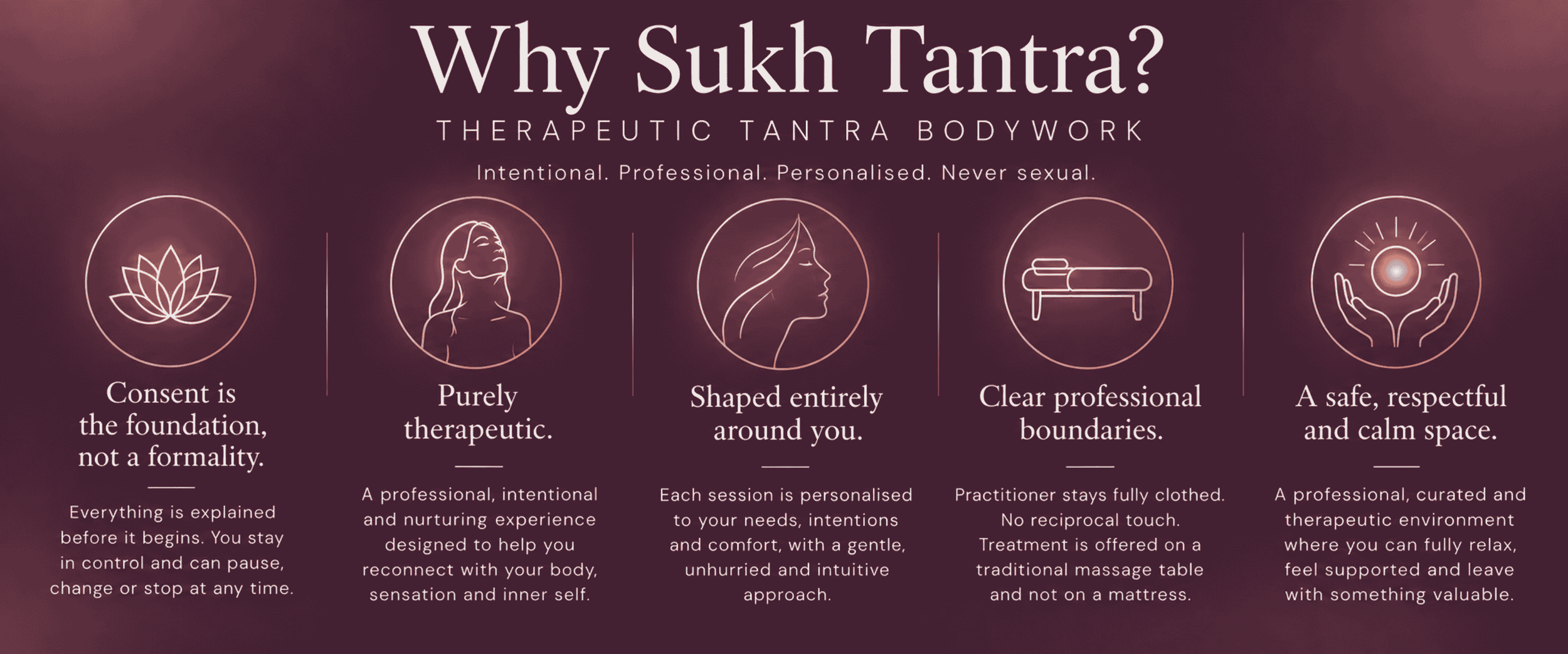
Tantra is often linked with sex, so to be clear: arousal and sexual gratification are not the aim of this work. Sessions take place on a traditional massage table, and touch goes one way only, with no body-to-body contact.
As a woman, you know intuitively what a touch intends. Here, it is pure and therapeutic.
For many women, this is the first time touch has come with no obligation attached, nothing to guard against or to reciprocate. In those moments, your body may begin to learn that openness and safety can exist together.
4. An invitation to ‘feel’ yourself fully

Tantra is often sold as a doorway to extraordinary experiences. Its quieter invitation is more meaningful, and more honest.
Tantric bodywork gives you structured, unhurried time to notice your breath, your sensations and your boundaries: where you soften, and where you protect yourself. It isn't a performance to chase or a reaction to produce.
So there's no pressure to get it right. You might feel relaxation, emotions, memories, insight, stillness, or something else entirely. What it offers is a space in which you can meet yourself, honestly and without hurry to:
breathe without immediately changing what you feel
notice a sensation without rushing toward it or away
Tantra can make space for emotions or memories — without inventing an explanation or need for a reaction for it
set down what you've carried so long it started to feel like you
let go of something you didn't realise you were holding
recognise a boundary before it has to become a wall
meet yourself again, not as you should be, but as you are
remember that your body, emotions, energy and inner knowing all belong to the same person- You
Tantra doesn't ask you to ‘fix’ anything or become anyone different.
It invites you to feel yourself fully — and to stop leaving parts of yourself behind.

5. Tantra changes the questions you ask about sexuality
43% women experience Sexual Dysfunction¹¹. Now it is a condition termed HSDD- Hypoactive (Low) Sexual Desire Dysfunction. Many women carry quiet questions about their sexuality:
"Why don't I respond faster?"
"Why don't I feel what I'm supposed to feel?"
"What's wrong with me?"
“Where is that me gone?”
“Why that part of me feels quiet, numb?”
Tantra asks kinder questions instead:
What do I notice?
What do I feel?
What does my body enjoy?
Where do I feel more, and where do I feel less?
What makes me soften, and what makes me tense?
What happens when nobody is rushing me?
What changes in me when there is nothing to perform or please anyone?
None of these has a universal answer. That's their value. The answers are yours.
6. What you discover here goes with you
There is sixth benefit. What you discover about yourself in the treatment room doesn’t have to stay there.
In Tantra session you practise small things: noticing what you feel. Trusting your own signals. Saying yes when you mean yes, and no when you mean no. Receiving without needing to give back. Taking up space without apologising for it.
In time, these can begin to show up in the rest of your life.
One woman put it simply:
“I feel more confident — from my bedroom to the boardroom.”
She emphasised MY.
I loved that sentence, because the confidence she meant was a quiet one. Knowing what she feels, what she wants and what she doesn’t. Less second-guessing. More ease in her own body, and in her own space.
For you, it might show up:
in a relationship, as saying what you need instead of swallowing or suppressing it
in intimacy, as knowing more clearly what feels good and what doesn’t
at work, as speaking without shrinking your opinion, or trusting your judgement before reaching for reassurance
or ut in the world, somewhere less visible: moving through your day a little more grounded, present and at ease
Once your body feels like home again, you carry that sense of home into everything else..
Why intimacy is part of your health and wellbeing, at every stage of life
For one woman it's wondering whether something is genuinely enjoyable or simply what she learned to go along with. For another it's wanting closeness after years of motherhood yet feeling touched-out by the end of each day, loving her partner while her own desire lags behind theirs, or the dryness and discomfort of perimenopause that nobody warned her about.
Intimacy also comes with plenty of strings attached: cultural taboos, strain in a relationship, performance pressures, the plain difficulty of finding words for any of it and for some, suffering in silence. So these concerns, far more common than most women realise,⁶ are rarely spoken aloud. Many women simply put up with things and decide this must be how it is now.
The research says they deserve more attention. A satisfying intimate life is associated with better mood, lower stress, better sleep, healthier vaginal tissue, stronger relationships, lower cardiovascular risk and even longer life.⁷ In a survey of 7,252 Australians, 84 per cent reported intimacy leading to more emotional satisfaction in their relationships,⁸ and good physical health than age.⁹ Desire doesn't come with a use-by date.
Earlier I said women seek safety and connection before anything else. The Basson model of female sexual response points the same way: for many women, desire doesn't arrive first but emerges once they feel safe, unhurried and connected.¹⁰ Anxiety, distraction or feeling unattractive can quietly get in the way.
Where Tantra fits
That's why intimacy as a feeling has a place on this page. A woman's intimate wellbeing is part of her health, and the conditions this research keeps returning to are the ones Tantra bodywork is built around: feeling safe, having time, and ease in your own body. The four elements described above are aimed squarely at those conditions, and research on mindfulness and body awareness, which share Tantra's emphasis on attention and breath, has linked them with improvements in women's desire, arousal and satisfaction.¹˒⁴
Whatever stage of life you're at, and whatever brought you here, you don't have to keep carrying these questions on your own.
Here's what the work itself involves.
What’s involved in Tantra bodywork
Tantra bodywork is a different way of experiencing your body. As I practise and understand it at Sukh Tantra,it is fundamentally about bringing awareness back into the body. An embodied practice of slowing down enough to experience yourself more fully.
Breath, touch, sensation, emotion and awareness aren't treated as separate parts of you, but as one living whole.
Instead of chasing an outcome, Tantra bodywork invites curiosity about what is here, right now:
A breath. Warmth. Tingling. Softness. Resistance. Pleasure. Memory. Emotion. Stillness.
Curiosity attracts more than expectation. Nothing to force, achieve, chase or perform.
In Tantra bodywork, the energy available in various body parts is channelised through sensation. Tantra understood it as life force: an aliveness that isn't confined to one place. With breath, unhurried touch, stillness and attention, sensation and energy can spread through your pelvis, belly, heart, spine and whole body.
Traditional Tantra describes this through chakras, energy pathways and energy rising towards the heart. In bodywork You might feel it’s forms as emotion, memories, release or just as being deeply present in your body. Either way, the invitation is the same:
Slow down. Feel more.
Let your body show you what it actually wants, not what it thinks it should.
Consent and your comfort is paramount. Boundaries are part of body awareness.
Every bodywork session ends with integration; integration is part of the whole experience, not an afterthought.
Where to Begin
You don't have to know exactly what you're looking for.
Perhaps you want to feel more.
Perhaps you want to slow down.
Perhaps something in you is simply curious.
Curiosity is enough.
If you're unsure what feels right, start with a conversation. A discreet Discovery Call lets you e-meet me and ask anything. There's no obligation to decide on the call, or to choose a particular bodywork.
If you feel ready for Tantra exploration, book a session.
The right place to start is simply where you feel comfortable.
Your questions, answered
-
Sukh Tantra is therapeutic bodywork, and the difference shows in six ways.
The intention. Arousal and sexual gratification are not the aim. Every session, every moment is therapeutic, focused on helping your body feel safe, settled and more your own.
The setting. Sessions take place in a professional studio on a traditional massage table, not a mattress or futon, and herbal oils are used generously.
The touch. Touch goes one way only, from practitioner to you, with no body-to-body contact. As a woman, you know intuitively what a touch intends. Here, it is therapeutic.
Your role. You only receive. No reciprocation of any kind is expected.
Your say. What your session includes is agreed in minute detail before it begins, and you can pause or change anything at any time.
Your first step. A complimentary, discreet video Discovery Call lets you ask anything before you book.
Tantra work here is not about becoming “More Sexual” but more about Becoming More Aware -
We don’t go into detailed comparison of different types of massages like remedial, sports or lymphatic. But here is a brief explanation.
Most massage focuses on the specific parts or muscles, easing tension, knots or injury.
Tantra massage works on whole body- as a starting difference. It believes that no part of you is less important than other.
Further, it comes from a tradition that sees the body as a way into awareness, so it works with the whole of you: body, breath and attention together.
The touch is slower and more flowing, with pauses that give your nervous system time to settle. Breath is woven through the session, and rather than drifting off, you're invited to be fully present- feeling relaxed, calm and serene at the same time- that’s where the gist is.
You lead throughout. Your role is only to receive. There's nothing to chase, and no particular response to reach.
What the session includes is agreed with you beforehand with a detailed consent process, and you can pause or change anything at any time.
After any Tantra session, women often say: feeling more at home in their own body, safe and calm.
-
That's honest, and more common than you'd think. Nervousness is welcome here; it doesn't have to go away before you begin.
Think of Tantra as bodywork with more attention paid to breath, presence and how you're feeling. Every step is explained before it begins, nothing intimate is ever assumed, and you set the pace throughout. Many women find that what felt daunting as a word feels quite natural as an experience.
Research from intimate care suggests that how a practitioner listens, explains and respects your choices matters more than their gender. Read more in our guide: What often matters more than gender of the Tantra practitioner?
If it helps, a discovery call is a low-pressure way to ask anything before you decide.
-
No. You need no spiritual background, no body confidence and no previous experience.
AS it’s purely therapeutic bodywork, question of sexuality or openness does not arise.
-
If you're unsure, begin with a discreet discovery call — the simplest way to ask your questions and work out together which service best matches what you're looking for.
A Tantric whole-body massage is what many choose as a starting point.
-
Because your inner life is your own. Discretion here is respect for your private world — the same care you'd expect from anyone you trust with something personal. Tantra still gets misread-as sexual, somewhat mysterious- and you shouldn't have to explain your choices to anyone. What you explore, and the fact that you chose to, stays with you.
-
No. Tantric bodywork is not medical care, psychotherapy or a substitute for it.
Some Tantra practices and bodywork help nervous system regulation and may therefore help to get relief from some effects of trauma but are not replacement for medical care where necessary.
Research Notes
The research cited here supports individual components that overlap with what Tantra offers, rather than Tantra as a complete clinical intervention.
Seal BN, Meston CM. A review of 29 studies found body awareness, particularly through mindfulness and sensate-focus approaches, to be relevant to female sexual response and wellbeing, while noting limitations in determining which components produced the effects.
Treves IN, et al. A 2025 meta-analysis of 29 randomised trials involving 2,191 participants found small-to-moderate improvements in self-reported interoceptive awareness following mindfulness-based interventions.
Laborde S, et al. A systematic review and meta-analysis of voluntary slow breathing found increases in vagally mediated heart-rate variability during and following slow-breathing practice.
Brotto LA, Basson R. In women seeking help for low sexual desire and arousal, a mindfulness-based intervention improved reported desire, arousal, lubrication, satisfaction and overall sexual functioning.
Brotto LA, et al. Randomised research has also found mindfulness-based cognitive therapy and structured sex education and support beneficial for women experiencing sexual interest and arousal difficulties.
Rosen, Current Psychiatry Reports, 2000;2:189–195. Sexual concerns are common among women and men.
Liss, Journal of Sexual Medicine, 2023;20:921–924. Smith, Sexual Behaviour and Health in Older Adults, Springer, 2023. Lusti-Narasimhan, Bulletin of the World Health Organization, 2013;91:707–709. A satisfying intimate life is associated with improved mood, emotional wellbeing, sleep, vaginal health, relationship satisfaction, lower cardiovascular risk and greater longevity.
Badcock, Sexual Health, 2014;11:427–438. A survey of 7,252 Australian women and men reported 84% emotional satisfaction and 76% physical pleasure in their relationships.
Lindau, New England Journal of Medicine, 2007;357(8):762–774. Hess, Journal of Sexual Medicine, 2009;6:1358–1368. Good physical health is a stronger predictor of sexual frequency and function than age.
Basson, Journal of Sex & Marital Therapy, 2001;27:33–43. Women's desire is often responsive, arising from emotional intimacy and receptivity rather than preceding it.
McCarthy, J. Contemp Psychotherapy,2008,38:139-149.