


New to Tantra?
A first timer’s guide to Tantra
Your most common questions answered

New to Tantra?
Curiousity is enough.
Maybe, something about Tantra has stayed with you.
And perhaps another part of you is quietly asking:
Is this really sexual? What actually happens? How much is expected of me? Can I change my mind? Is this really for someone like me?
They're good questions. This page answers each one plainly.
You don't need to understand Tantra, feel confident.
You don't have to arrive with a problem, either.
You can be curious, cautious, a little excited and a little nervous — all at the same time.
First, the biggest mis-understanding.
Somehow, Tantra got equated with sex. But,
Reducing Tantra to sex is like mistaking music for noise.
Tantra is a far wider tradition of breath, body, awareness and presence. The idea that it is about sex is largely a modern misconception.¹ You can read full differences in the blog here or on page What is Tantra.
The table below explains the difference in nutshell.
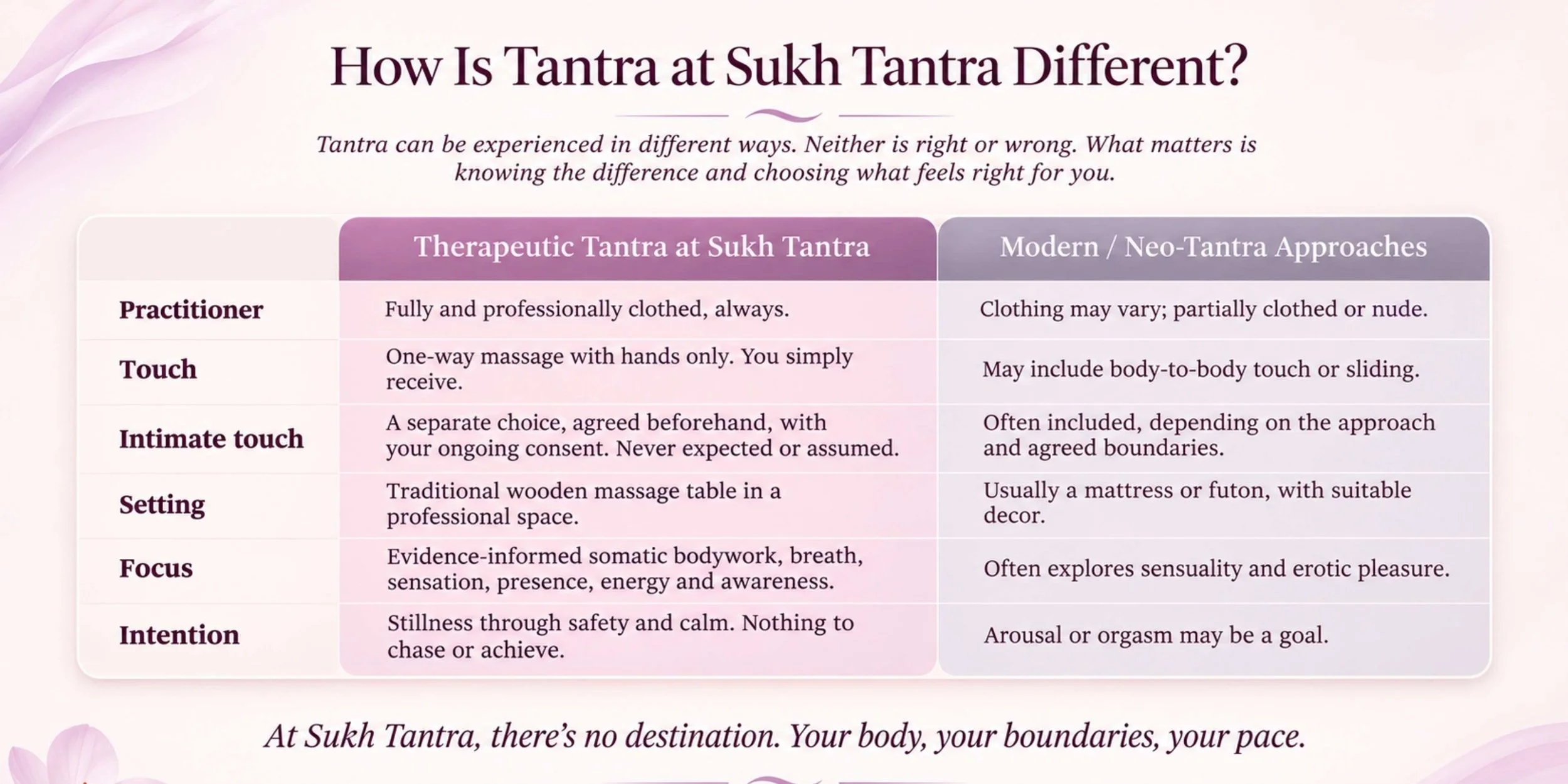

What Tantra here is really about
Tantra at Sukh Tantra is intentionally therapeutic. It is about slowing down, reconnecting with yourself and experiencing your body with greater awareness — without pressure, expectations or boundaries to push past.
Slowing down enough to feel yourself again.
For one woman, that may mean deep rest.
For another, learning to receive without guilt.
For another, reconnecting with a body that has felt distant for years.
For another, feeling safe again in the body, that has learnt to brace after difficult experiences.
For another, understanding desire or intimacy differently.
And sometimes it begins with simple: "I'm curious."
That itself is enough.
How Therapeutic Tantra works
At Sukh Tantra, therapeutic describes the intention behind the bodywork — to support relaxation, body awareness, reconnection and a greater sense of wellbeing.
Through mindful touch, breath and present-moment awareness, Tantra invites you to slow down, soften and reconnect with what you're actually feeling in your body. Research into mindfulness, interoception and body-oriented approaches suggests benefits for body awareness and wellbeing, while studies of massage during menopause have reported positive psychological outcomes.⁵ ⁶ ⁷ ⁸ ⁹
Sensation Brings You Back to the Here and Now
So much of our attention is caught between yesterday's memories, tomorrow's worries and everything in-between demanding our attention.
Tantra offers a different experience — an invitation to step out of constant thinking and into sensation.
Warmth. Pressure. Tingling. Softness. Tension. Breath. Pleasure. Relief. Stillness.
As your attention settles into what you're actually feeling, the mind may grow quieter, the body may soften, and the present moment becomes more vivid. There's nothing to analyse, perform or achieve. Simply notice, feel and receive.
Where Attention Goes, Energy Flows
Tantric traditions have long explored the relationship between attention, sensation, energy and awareness.
In simple terms, what you bring your attention to becomes more alive in your experience.
As awareness returns to your breath and bodily sensations, you may begin to feel more grounded, present and connected with yourself.
For some women, that may bring deep relaxation; for others, renewed sensation, emotional ease, clarity, pleasure or a quiet sense of wholeness. Sometimes, it's simply the experience of profound stillness.
This is what makes therapeutic Tantra bodywork different: Not only that it invites the ‘whole’ of you but how deeply the experience invites you to be present with yourself.
Its therapeutic potential lies not in promising a cure, but in creating space for greater awareness, relaxation and reconnection — at your own pace.
Every woman's experience is individual.
Your first session: what actually happens
Before you come
There's very little you need to prepare. Everything is explained in your booking confirmation email.
Arrive reasonably hydrated, without rushing, and ideally leave some breathing space afterwards. Allow approximately an extra hour beyond your booked bodywork duration for the conversation beforehand and time to settle afterwards. Sessions most often go over time. This isn't an experience to squeeze into a busy day.
When you arrive
You'll meet Josh and begin with a relaxed conversation. What brings you here? What are you hoping to experience? Is there anything you're curious or uncertain about?
Josh will walk you through the session, explain what each stage involves and answer all your questions. Your preferences and boundaries are discussed and recorded in your consent form before anything begins, so you know exactly what you're agreeing to.
Nothing is assumed. Your comfort and choices guide the session.
How the Bodywork begins
Everything unfolds slowly, without rushing. There's no mood to create, no performance expected and no response you're expected to produce.
Typically, we begin with simple Tantra-informed breathwork to help you move away from the busyness of the day and gently return to your body. From there, the experience moves into slow, nurturing, warm-oil bodywork, according to your chosen therapy and agreed boundaries.
From there, the session moves into slow, warm-oil, whole-body massage work.
Breathe. Notice. Receive.
If you want anything changed — pace, pressure, a pause, or to stop — you simply say so. Choice stays with you throughout — a core principle of trauma-informed care we follow.²
Each Tantra experience is explained in more detail on its own page: Tantra Massage, Yoni Mapping and Pleasure Compass.
When the session ends
There's time to rest, settle and return to your day gradually. No need to jump straight up or make sense of everything immediately.
Some women feel deeply relaxed, calm³, quiet or reflective. Others notice emotional release, renewed energy, lightness or simply the relief of having slowed down. Many consistently say feeling safe and calm in their body, again.
Often, the most meaningful feeling is simply being comfortable in your own body again.
There's no right way to feel afterwards, and nothing you need to analyse or achieve. We allow time to reflect and integrate the experience.
Sometimes the most useful thing is simply to give yourself a little space — and notice what remains when everything has gone quiet.
The care that continues
very Tantra bodywork session at Sukh Tantra includes a complimentary follow-up session, where we share simple practices drawn from ancient Tantric traditions to help you carry greater presence, awareness and connection into everyday life.
Something to keep you for life, long after the massage ends.
Beyond conditioning: Embracing the Whole of You
Let me ask you something. Which part of your body would you call unimportant? And which parts have you wished were different, quietly carried shame about, or simply stopped paying attention to? The truth is, every part of you matters. Nothing is spare, nothing is a mistake.
Yet we've been conditioned to value certain parts of our bodies while judging or neglecting others — especially our intimate areas. These parts play essential roles in urination, menstruation, reproduction, childbirth and sensation, yet we often see them almost entirely through the lens of sexuality or taboo.
Over time, those parts can remain outside our awareness — carrying tension, guardedness or simply a sense of disconnection that we may not even notice. Tantra believes that anything unprocessed, suppressed also starts to gather in those parts, manifesting sometimes as symptoms or conditions, when ripened.
Why does caring touch on your shoulders feel natural, while intimate touch carries such a different meaning? Is it the touch itself, or what we've been taught it means?
That’s why therapeutic Tantra takes a different approach. It invites you to look beyond that conditioning and rediscover your body as a whole — worthy of care, awareness and acceptance. It does not divide the body into the parts that are acceptable to feel and the parts that should be ignored. No part of you needs to be left behind.
Tantra invites you to experience yourself as a whole.
Words can’t fully explain some experiences — they have to be ‘experienced’.
Importantly, intimate touch is always your choice and here is how you choice and boundaries are respected at Sukh Tantra.
What women often want to know
"Do I have to undress?"
Only as far as you're comfortable.
Everything is agreed before the session begins — never decided on the table. And like everything else, it can change at any time.
"What if I feel self-conscious about my body?"
You arrive as you are.
Bodies change through age, motherhood, menopause, illness, stress, surgery, relationships — and simply living. Nothing here is being assessed. Whole of you is welome, where you are at.
Many women learn to see their bodies from the outside, and research suggests that habit can quieten how much we feel from within.⁴ Tantra invites a different question from "How does my body look?" to “What I feel and where?” and may explore “what it means?” or “How does it feel to live inside it?”
Is intimate touch part of every Tantra session?
No. Intimate touch is never required or assumed. Some of our Tantra bodywork experiences offer it as a separate, optional element, discussed and agreed before the session, with your ongoing consent. You can choose a session without intimate touch, and your experience is no less meaningful for that choice. Your boundaries are respected throughout, and you can change your mind at any time.
"What if I get emotional?"
Everything is welcome.
Tears, laughter, deep tiredness, big sighs of relief or simply going very quiet — all of it is normal when the body finally slows down, and none of it needs explaining.
You will feel supported and held throughout the session.
"Can I change my mind?"
Nothing is set in stone. You can change your mind during the session, can pause, stop, restart at any time. No questions asked.
Even after you book a session, you can change your mind on the day and get a refund as per our fair and friendly terms.
Please refer to respective Tantra bodywork pages for FAQs specific to those bodyworks.
For questions re refund, policies etc, please refer to the Terms.
Start where you feel comfortable
If you're interested but still have questions, begin with a conversation.
A private, no-obligation Discovery Call — by phone, video or in person — lets you meet Josh, ask the awkward questions, understand the boundaries and decide in your own time whether this feels right.
Clarity first. Trust next. Everything else at your pace.
Professional · Confidential · Consent-led · For Women
Already feel ready for a session?
A gentle Taste of Tantra — Bodywork without intimate touch
Perhaps you're drawn to Tantra, but not quite ready for intimate touch?
That's perfectly fine.
You can still experience the nurturing presence, mindful touch and deep relaxation that are at the heart of Sukh Tantra — without any intimate touch.
Our Art of Receiving and Chakra Balancing & Aura Cleansing massages offer a gentle way to begin. An opportunity to relax deeply and become comfortable with our approach, in your own time.
Sometimes, the most beautiful beginning is simply allowing yourself to receive.
References
Urban, H. B. (2003). Tantra: Sex, Secrecy, Politics, and Power in the Study of Religion. University of California Press. Project MUSE
Blue Knot Foundation (2023). Becoming Trauma Informed – Services (fact sheet). Core principles: safety, trustworthiness, choice, collaboration and empowerment.
Moyer, C. A., Rounds, J., & Hannum, J. W. (2004). A meta-analysis of massage therapy research. Psychological Bulletin, 130(1), 3–18. doi.org/10.1037/0033-2909.130.1.3
Fredrickson, B. L., & Roberts, T.-A. (1997). Objectification theory: Toward understanding women's lived experiences and mental health risks. Psychology of Women Quarterly, 21(2), 173–206. doi.org/10.1111/j.1471-6402.1997.tb00108.x — and Ainley, V., & Tsakiris, M. (2013). Body conscious? Interoceptive awareness, measured by heartbeat perception, is negatively correlated with self-objectification. PLoS ONE, 8(2), e55568.
Molteni, L., Gosling, C. J., Fagan, H. A., et al. (2024). Effects of mindfulness-based interventions on symptoms and interoception in trauma-related disorders and exposure to traumatic events: Systematic review and meta-analysis. Psychiatry Research, 336, 115897.
Heim, N., Bobou, M., Tanzer, M., Jenkinson, P. M., Steinert, C., & Fotopoulou, A. (2023). Psychological interventions for interoception in mental health disorders: A systematic review of randomized-controlled trials. Psychiatry and Clinical Neurosciences, 77(10), 530–540.
van de Kamp, M. M., et al. (2023). Body- and movement-oriented interventions for posttraumatic stress disorder: An updated systematic review and meta-analysis. Journal of Traumatic Stress, 36(5), 835–848.
Kuhfuß, M., Maldei, T., Hetmanek, A., & Baumann, N. (2021). Somatic experiencing — effectiveness and key factors of a body-oriented trauma therapy: A scoping literature review. European Journal of Psychotraumatology, 12(1), 1929023.
Lu, X., Xu, X., Shi, X., et al. (2026). Can massage ameliorate menopausal and postmenopausal symptoms in women? A systematic review and meta-analysis. Complementary Therapies in Medicine, 98, 103370.